
Visual Bra Size Chart with Pictures: Real Cup Size Comparisons & International Matrix
One of the most pervasive myths in intimate apparel is what specific bra sizes actually “look” like. Pop culture has conditioned society to believe that an A-cup is completely flat, a C-cup is average, and a DD-cup is enormous. In reality, human anatomy and garment engineering tell a completely different story.
Cup letters are dynamic ratios, not static volumes. A 28D and a 38D hold radically different amounts of breast tissue. Below, you will find our complete visual bra size chart with real cup comparisons, sister size volume physics, anatomical fit diagnostics, and the master international conversion matrix.
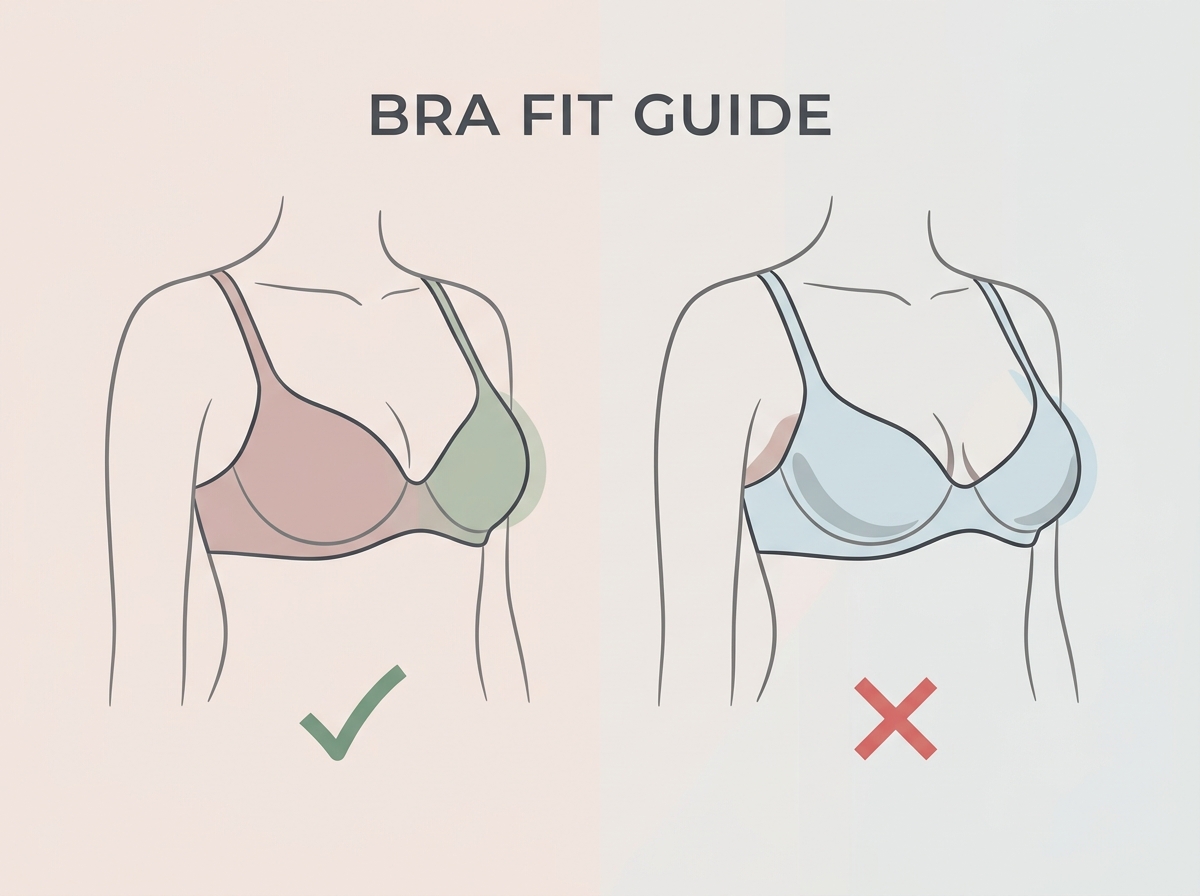
1. Real Cup Size Visuals: What Cups Actually Look Like
Each cup letter simply represents an additional 1-inch (2.54 cm) difference between your ribcage underbust and full bust circumference. Here is how that translates to real-world visual proportions:
Petite to Moderate: A, B & C
A Cup (~100-180cc): Subtle forward projection. On a 30A or 32A, breast tissue sits shallow against the pectoral wall. On a 38A, tissue spreads across a broader chest plate.
B Cup (~200-320cc): Moderate contour. A correctly fitted 30B is significantly smaller in overall mass than society imagines.
C Cup (~350-480cc): The classic 3-inch ratio. Often considered the baseline average, but looks completely different on a 30C vs a 36C.
Medium to Full: D, DD/E & F
D Cup (~500-680cc): Exactly a 4-inch bust difference. On a 28 or 30 band (28D, 30D), breasts appear compact, athletic, and perky. On a 38 band (38D), volume is visibly substantial.
DD / E Cup (~700-880cc): 5-inch projection. A 30DD is extremely common among slender women and does not look “huge.”
DDD / F Cup (~900-1,150cc): 6-inch projection. Often squeezed into 36DD due to mall store inventory limitations.
Full Bust: FF, G, GG & H+
FF & G Cups (~1,200-1,600cc): 8 to 9-inch projection. When supported by a firm, properly anchored band, tissue lifts cleanly off the ribcage, creating an hourglass silhouette.
GG & H Cups (~1,700-2,100cc): 10 to 11-inch projection. Requires three-piece seamed cups and reinforced side support slings.
Beyond H (J, JJ, K+): High tissue mass requiring wide underwires to prevent side breast tissue pinching.
2. Cup Volume & Anatomical Displacement Matrix
Medical breast volume estimations in cubic centimeters (cc) and approximate tissue mass across standard band sizes:
| Cup Letter (US / UK) | Bust Delta (Inches) | Bust Delta (cm) | Avg Volume per Breast (cc) | Visual Profile |
|---|---|---|---|---|
| AA | < 1" | < 2.5 cm | ~50 – 90 cc | Very shallow, subtle contour |
| A | 1" | 2.5 cm | ~100 – 180 cc | Shallow projection, broad root |
| B | 2" | 5.0 cm | ~200 – 320 cc | Moderate natural curvature |
| C | 3" | 7.5 cm | ~350 – 480 cc | Balanced forward projection |
| D | 4" | 10.0 cm | ~500 – 680 cc | Clearly defined, projected |
| DD / E | 5" | 12.5 cm | ~700 – 880 cc | Full silhouette, pronounced mass |
| DDD / F (UK) | 6" | 15.0 cm | ~900 – 1,150 cc | Substantial projection, heavy root |
| G / GG (UK) | 8" – 10" | 20.0 – 25.0 cm | ~1,300 – 1,800 cc | Full figure, dense displacement |
3. International Size Conversion Matrices
Search or filter below to highlight equivalent band and cup sizes across 10 regions.
Band Size Conversion MatrixUS / UK / EU / FR / AU / JP / IN / HK / KR / SG
| US / CA | UK | EU | FR / BE / ES | AU / NZ | JP | India (IN) | Hong Kong (HK) | South Korea (KR) | Singapore (SG) |
|---|---|---|---|---|---|---|---|---|---|
| 30 | 30 | 65 | 80 | 8 | 65 | 30 | 65 | 65 | 65 |
| 32 | 32 | 70 | 85 | 10 | 70 | 32 | 70 | 70 | 70 |
| 34 | 34 | 75 | 90 | 12 | 75 | 34 | 75 | 75 | 75 |
| 36 | 36 | 80 | 95 | 14 | 80 | 36 | 80 | 80 | 80 |
| 38 | 38 | 85 | 100 | 16 | 85 | 38 | 85 | 85 | 85 |
| 40 | 40 | 90 | 105 | 18 | 90 | 40 | 90 | 90 | 90 |
Cup Size Conversion MatrixUS / UK / EU / AU / JP / IN / HK / KR / SG
| US / CA | UK | EU | AU / NZ | JP | India (IN) | Hong Kong (HK) | South Korea (KR) | Singapore (SG) |
|---|---|---|---|---|---|---|---|---|
| A | A | A | A | A | A | A | A | A |
| B | B | B | B | B | B | B | B | B |
| C | C | C | C | C | C | C | C | C |
| D | D | D | D | D | D | D | D | D |
| DD / E | DD | E | DD | E | DD / E | E | E | E |
| DDD / F | E | F | E | F | E / F | F | F | F |
| G | F | G | F | G | F / G | G | G | G |
| H | FF | H | FF | H | G / H | H | H | H |
| I | G | I | G | I | H | I | I | I |
| J | GG | J | GG | J | I | J | J | J |
4. Sister Sizing Physics: Identical Volume on Different Bodies
Sister sizes are sizes that hold the exact same cup volume, but are paired with different ribcage band measurements. If you increase the band size, you must decrease the cup letter to preserve identical volume.
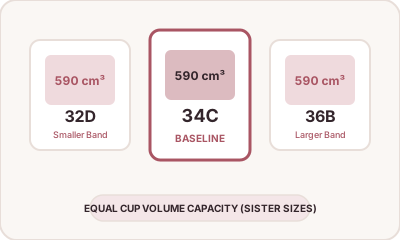
| Volume Tier | Narrow Band (Small Ribs) | Medium Band (Average) | Wide Band (Broad Ribs) |
|---|---|---|---|
| Tier 1 (~390cc) | 30D | 32C | 34B |
| Tier 2 (~710cc) | 28G | 32E (UK) | 36D |
| Tier 3 (~1,180cc) | 32H (UK) | 36FF (UK) | 40E (UK) |
The Visual Takeaway: In Tier 2, the 28G appears heavily projected because 710cc of tissue is concentrated on a slender 28-inch ribcage. In contrast, the 36D holding the exact same 710cc spreads across a broader chest wall, appearing much flatter. For dynamic calculations, explore our interactive Sister Size Calculator.
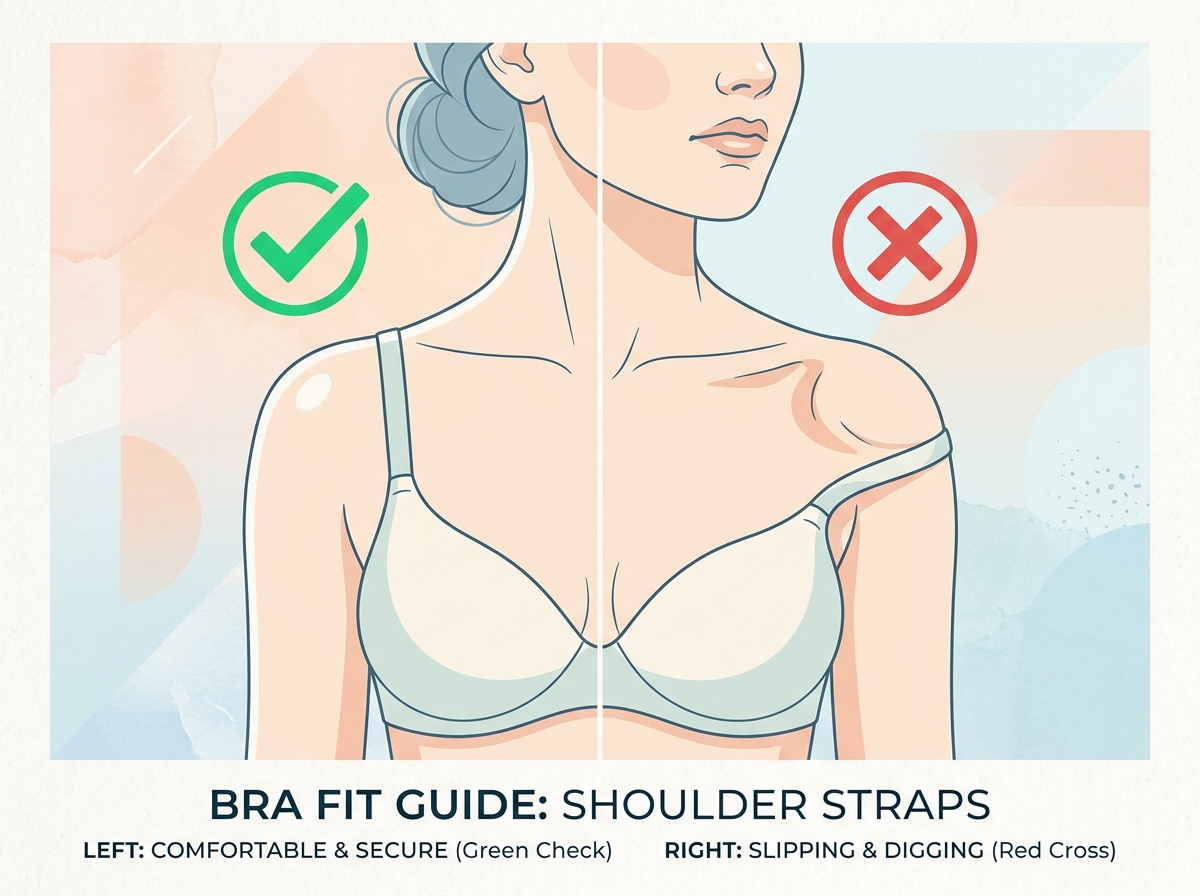
5. Diagnosing Fit Through Visuals: The 4 Red Flags
When looking in the mirror, consult these four anatomical warning signs to diagnose why your bra is uncomfortable:
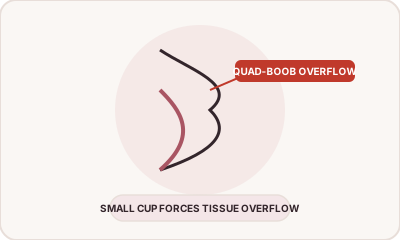
1. The “Quad-Boob” (Cup Spillage)
Breast tissue bulges over the top rim or underarm edges of the cup, forming a double curve under clothing.
Fix: Go up 1 to 2 cup sizes.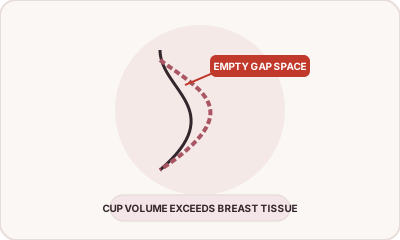
2. Cup Gaping & Wrinkling
Hollow empty gaps appear at the top of the cup, or fabric folds when you sit down.
Fix: Size down in cup, or switch from molded to unlined seamed cups.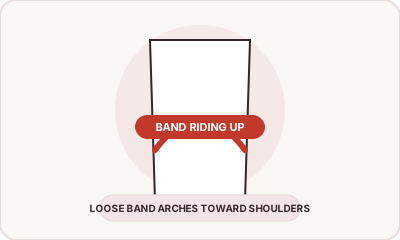
3. The Riding Back Band
The band forms an upward arch across your spine rather than anchoring straight and horizontal to the floor.
Fix: Size down in band (e.g., 36 to 34) and up in cup.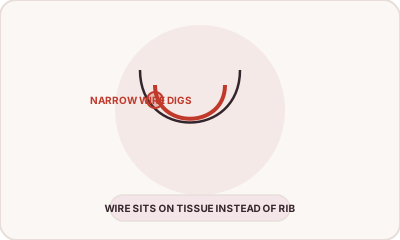
4. Underwire Poking Breast Tissue
The wire terminates on soft breast tissue at the underarms or fails to sit completely flush against the sternum.
Fix: Increase cup volume to widen wire root diameter.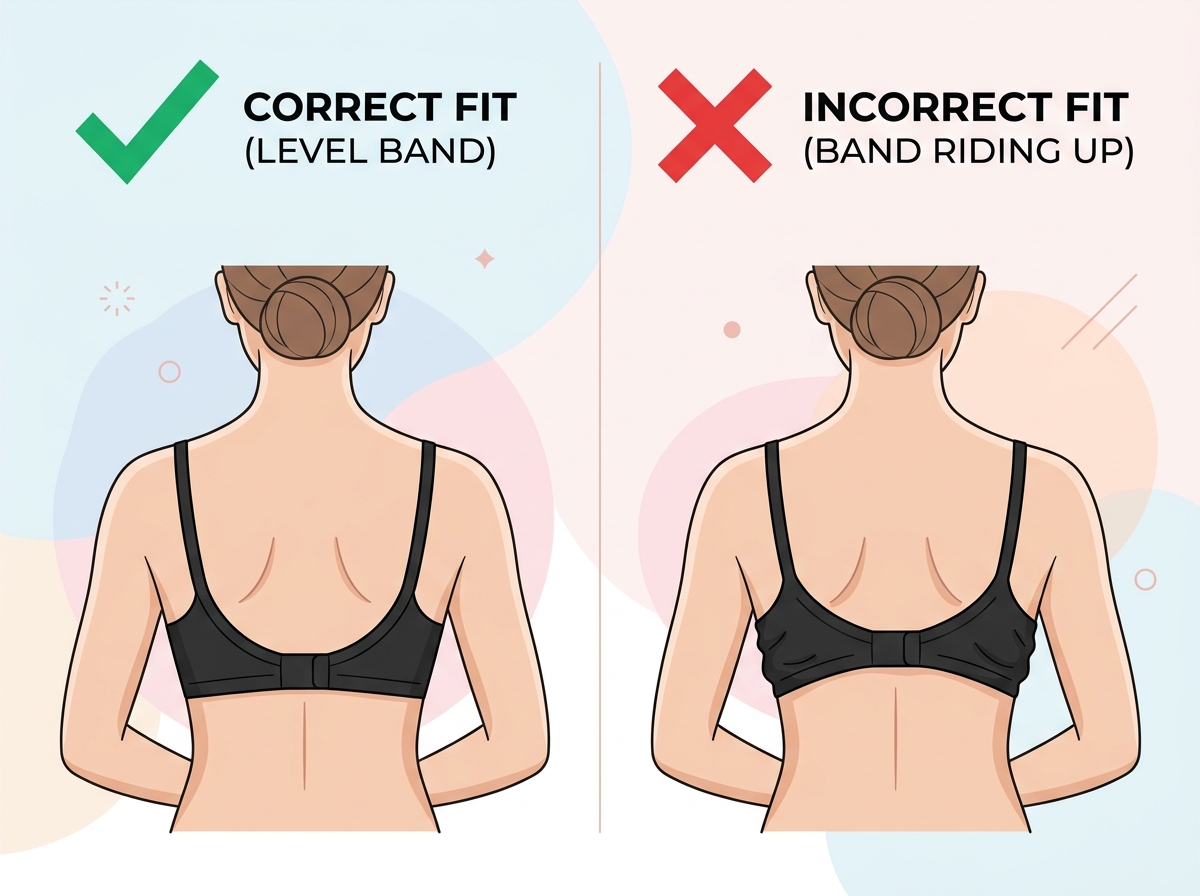
6. Why Breast Shape Dictates Visual Appearance
Two people with the exact same 34D measurements can look visually unalike because of how breast tissue is anchored to the chest wall:
Projected vs. Shallow
Projected: Tissue extends outward from the ribcage like a cone or glass. Looks larger visually in profile; best suited for deep, unlined seamed balconette cups.
Shallow: Tissue is distributed broadly over a wide chest area. Appears smaller visually in clothing; best suited for demi, push-up, or wide-wire balconette styles.
Full on Top vs. Full on Bottom
Full on Top (FoT): Greater tissue mass above the nipple. Prone to cup spillage in plunge bras; excels in open-top half cups.
Full on Bottom (FoB): Greater tissue mass below the nipple. Prone to gaping at the upper edge in rigid foam bras; excels in plunge and teardrop cups.
Medical & Ergonomic Guidelines
Improper bra fit is a leading contributor to chronic musculoskeletal strain, trapezius spasms, and thoracic posture deviation. Consult authoritative clinical health resources for biomechanical fitting guidance:
7. Frequently Asked Questions About Visual Sizing
What does a visual bra size chart show?↓
A visual bra size chart demonstrates how breast tissue volume distributes across different band sizes. Because cup letters represent a ratio (bust circumference minus underbust circumference) rather than a fixed mass, a 30D appears much more compact than a 38D despite both sharing the same 'D' cup letter.
What do different cup sizes look like in real life?↓
In reality, an A cup represents a 1-inch difference between underbust and bust (~100-180cc per breast), a B cup represents 2 inches (~200-320cc), a C cup represents 3 inches (~350-480cc), a D cup represents 4 inches (~500-680cc), and a DD/E represents 5 inches (~700-880cc). On a petite band (like 28 or 30), a D or DD looks moderate and compact rather than oversized.
Why does a 34D look smaller on some people and larger on others?↓
Breast appearance depends heavily on tissue projection, breast root width, and chest wall circumference. Projected breasts extend further forward from the chest and look larger, while shallow breasts spread tissue widely across the ribs and appear more subtle, even with identical 4-inch measurements.
How do sister sizes work visually?↓
Sister sizes hold the exact same physical volume of breast tissue mounted on different ribcage circumferences. For example, a 30D, 32C, and 34B all contain approximately 390cc of tissue. The 30D concentrates this tissue on a narrow frame (looking fuller), whereas the 34B spreads it across a wider torso (looking shallower).
How do I read the international conversion matrix?↓
Locate your snug underbust measurement on the Band Matrix row to see your equivalent band across US, UK, EU, FR, AU, JP, and IN. Next, find your bust-to-band difference on the Cup Matrix to determine your regional cup letter. Combine the two for your converted international size.
Are UK and US bra cup sizes the same?↓
US and UK cup sizing are identical from A up to DD. Above DD, the systems diverge significantly. The UK uses double letters (DD, E, F, FF, G, GG, H), while US sizing skips double letters (DDD/F, G, H, I, J). A UK 32G equals a US 32I.
Why do Asian bra sizes use centimeter bands?↓
Asian sizing (Japan JIS L 4006 and South Korea KS K 9404) uses actual metric ribcage circumferences (65, 70, 75, 80cm) and 2.5cm cup steps, providing consistent and precise fit metrics compared to traditional imperial systems.
What are visual signs that my bra does not fit?↓
The four classic visual warning signs are: 1) The 'Quad-Boob' where tissue spills over cup rims; 2) The floating center gore that doesn't rest flat against the sternum; 3) The band riding upward toward shoulder blades; and 4) Underwires resting directly on breast tissue at the underarms.
How often should I re-measure my bra size?↓
We recommend checking your measurements every 6 months, or whenever you experience weight fluctuations, hormonal shifts, pregnancy, nursing, or changes in fitness routines. Ribcage dimensions and breast density naturally change over time.
Can breast shape make a bra cup gape even if the size is correct?↓
Yes. If you have shallow or teardrop-shaped breasts and wear a stiff molded foam cup designed for projected tissue, empty space will appear at the top. Switching to an unlined, seamed balconette bra often solves gaping without changing size.
Stop Guessing. Calculate Your Exact Size in Seconds
Combine what you see with anatomical measuring formulas. Our 6-point algorithmic calculator delivers precision recommendations across US, UK, and EU systems.